
La Salle County Release Meaning
“Released” marks the end of one agency’s custody episode. It does not always mean that a person walked into the community. The La Salle County Sheriff may release someone on bond, after time served, after dismissal, or under a court order. The same record may instead show a transfer to the Texas Department of Criminal Justice, another county, the United States Marshals Service, or Immigration and Customs Enforcement. A hospital movement or death can also end a jail listing without being a community release.
The source record matters. For the La Salle County Jail, ask the sheriff for the booking and release sheet plus any movement or transfer record. A court order explains the legal basis, but it may precede the moment staff complete physical release. For Cotulla Unit, use TDCJ records. For the Regional Detention Center, identify whether ICE or USMS held the person before choosing a locator. One name search cannot reliably cover all three.
- Release
- The end of a particular custodian’s control.
- Discharge
- Completion of a sentence or supervision term, not merely departure from a building.
- Time served
- Release based on custody credit satisfying the ordered jail term.
- Detainer
- A request or legal hold that may send a person to another custodian.
La Salle County Release Types
The release reason determines the next record to check. Bond ends the current jail stay while the criminal case remains open. A dismissal can end the legal basis for one charge, though another hold may remain. Transfer ends custody at one location but continues custody elsewhere. Parole permits a state prisoner to serve part of a sentence in the community under conditions, while probation, formally called community supervision in Texas, is imposed by a court.
| Release entry | Meaning | Next source |
|---|---|---|
| Bond | Jail stay ends after bond requirements and hold checks | Sheriff release record and clerk docket |
| Time served or court order | County custody ends under a judgment or order | Release sheet and final court order |
| TDCJ transfer | County jail custody ends; state custody begins | TDCJ offender search |
| ICE or USMS transfer | Custody continues under a federal authority | ODLS, facility record, or federal docket |
| Parole or mandatory supervision | Prison custody ends with supervised status | TDCJ search and Parole Division |
| Sentence discharge | The sentence reaches its recorded endpoint | TDCJ incarceration history |
Never translate a local disposition code by borrowing another county’s legend. Ask La Salle County for the code definitions in use when the record was made.
La Salle County Release Record Fields
A useful record ties a person to one booking and states the outcome of that episode. Name alone is weak because people can share names and one person can have several bookings. Request the booking number, identifying data, and a narrow date range. Then read the destination with the release reason.
| Field | What it shows |
|---|---|
| Booking number | The specific county custody episode |
| Booking date and time | When intake was recorded, which may differ from arrest time |
| Charge and cause number | The alleged matter and link to the court file |
| Bond type and amount | A possible release route; a set bond is not proof it was posted |
| Release date and time | The recorded end of this custodian’s episode |
| Release type or disposition | Bond, court order, time served, transfer, or another coded result |
| Receiving agency or location | Whether another agency took custody |
The strongest confirmation combines date, time, disposition, and destination. A blank destination is not proof of community release. Ask the sheriff to clarify whether the field was left blank, withheld, or not kept in that form.
Request La Salle County Release Records
La Salle County publishes an open-records gateway that routes requests to its GovQA Public Records Center. No sheriff-specific fee schedule, promised completion date, jail-record hours, or online retention period was found in the August 2026 research. Ask for an electronic copy and a cost estimate. Texas Government Code Chapter 552 governs agency-held public information, but exceptions and redactions can apply to law-enforcement files.
- Identify the person by full name, date of birth, and booking number if known.
- Give the booking date or a narrow date range. Name the records as maintained: booking/release sheet, movement or transfer log, and any code legend.
- Request release date and time, disposition, and receiving agency. Ask separately for a booking photograph if needed for identification.
- Submit through GovQA and retain the confirmation. Respond to any scope, cost, or identity question.
- If only current status arrives, follow up for the historical release entry and destination.
La Salle County Sheriff’s Office
101 Courthouse Square
Cotulla, TX 78014
830-879-3044
Precision makes a request easier to process. Ask for records “as maintained” rather than asking the county to answer questions or build a new list. Separate the booking and release sheet from the jail movement log and booking photograph. If an entry says “transferred,” request the receiving agency and transfer date. When a response uses a code, ask for the legend that applied on that date. Preserve the agency correspondence and any legal basis given for a redaction or withholding.
Older records require the same care. The research found no official online roster and thus no online retention period to quote. Underlying agency records may remain even though no public search exists. If the county says an item is no longer kept, ask which retention rule applied and whether another office holds the related court record. The combined clerk can confirm a judgment or order, but it cannot replace the sheriff’s physical release timestamp.
Texas Attorney General ruling OR2019-14884 shows that La Salle County Sheriff material can require item-by-item analysis under Sections 552.101, .103, .108, .130, and .147. It does not guarantee that every narrative, identifier, or photograph will be released.
La Salle Release Records After Orders
Later court orders can change public access. Texas Code of Criminal Procedure Chapter 55A now governs expunction, which addresses covered records through a court order. Government Code Chapter 411 governs orders of nondisclosure, which restrict public dissemination while allowing access by authorized entities. Release, dismissal, or sentence completion alone does not make every case eligible for either remedy.
A missing result after an order is not a new release event. Confirm the historical custody endpoint with the appropriate agency and obtain legal advice from a qualified source when eligibility or compliance is at issue. The Texas Judicial Branch nondisclosure materials provide current official forms and statutory routing.
Bonding Out in La Salle
The official sheriff page states that the sheriff accepts bail for people in custody. Posting bond can end the La Salle County Jail stay, but it does not end the criminal case. Staff must still complete paperwork and check for other holds. The booking record should show whether the person physically left, while the clerk’s bond order and later docket show what happened in court.
No official local bond schedule or verified pretrial-services process was found. Confirm the accepted method, amount, current policy, and any remaining hold with the sheriff and court. “Bond set” and “bond posted” are different facts, and neither alone resolves a transfer to another agency.
La Salle Jail Release Scale
The Texas Commission on Jail Standards cited a 47-bed county capacity and a historical local average daily population of 29. Its method excludes contract inmates and private contract-only populations. Those figures describe scale, not current occupancy or annual releases.
Do not combine the small county jail figures with the much larger Regional Detention Center. The regional facility serves federal or immigration custody functions and has a different locator and release path. Mixing those populations creates a false picture of La Salle County releases.
Find La Salle County Released Inmates
Start with the last known facility, not a broad name result. The La Salle County official site has no verified live roster, recent-release archive, or rolling release feed. That absence makes a named sheriff inquiry and GovQA request the primary path for a county-jail release. State, federal, and immigration cases require different identifiers and sources.
- For the county jail, call the sheriff and request the release or transfer record through GovQA.
- Compare the cause number with the combined District and County Clerk docket and final orders.
- For a TDCJ commitment or Cotulla Unit stay, search by TDCJ number or exact name and verify the detail record.
- For notifications, check Texas IVSS-Counties, while treating a nonmatch only as no result.
- For a USMS, BOP, or ICE matter, use the responsible federal channel and the court record.
Recheck spelling, date of birth, agency number, and date range. If a portal drops an older record, request incarceration history from the originating custodian. A durable release record is stronger than a third-party copy.
La Salle TDCJ Release Search
The TDCJ online inmate search is the right first portal for a person committed to state prison or held at Cotulla Unit. Search by TDCJ number when possible. A name search may also be used, while TDCJ’s email service asks for full name plus TDCJ number, or full name with date of birth or age and county of conviction.
| Input or field | Use |
|---|---|
| TDCJ number | Strong state-system identifier |
| SID number | Texas criminal-history identifier when supported |
| Name and DOB or age | Biographic fallback that needs close matching |
| Location and offense | Helps separate similar names |
| Projected Release Date | A forecast, not proof of physical release |
| Scheduled Release date/location | Advanced processing detail that can still change |
| Parole review information | Eligibility or review status, not discharge |
The official query screen shows the state search fields. Open the TDCJ search source before comparing the interface below.
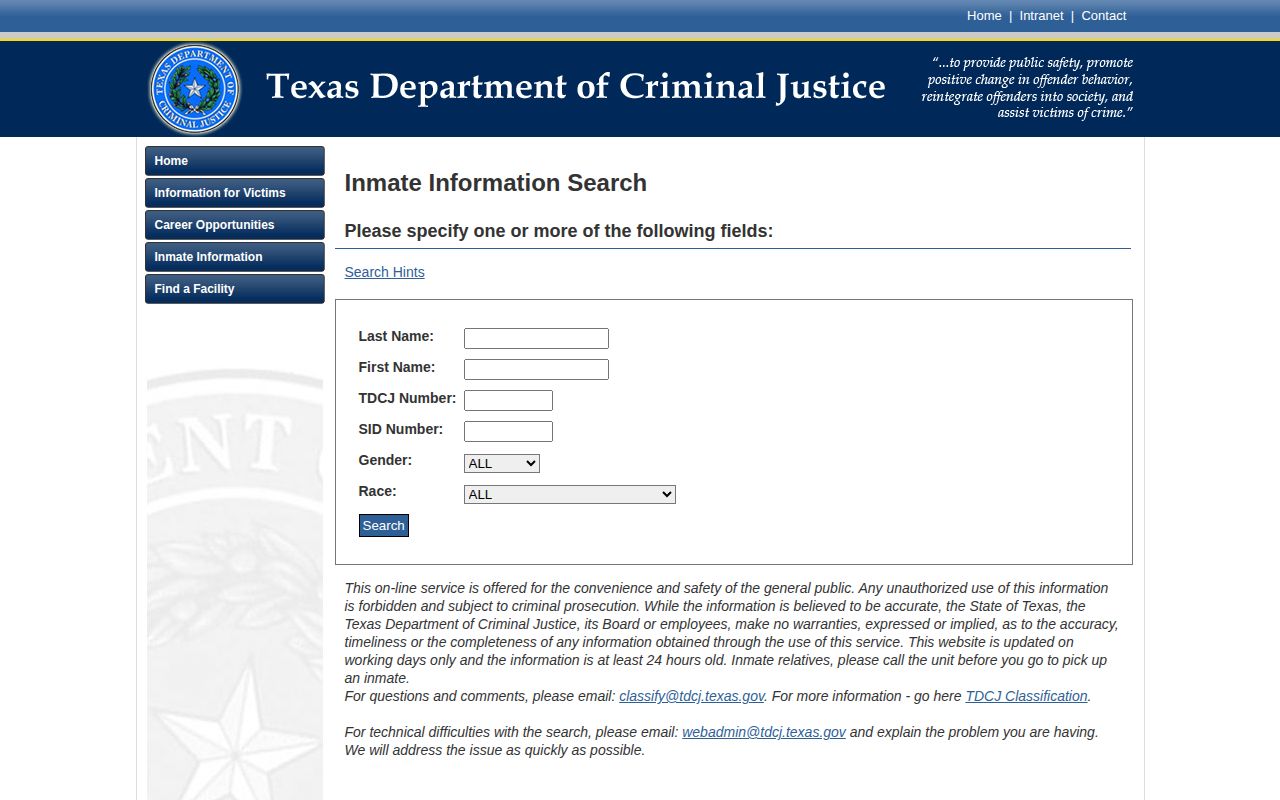
The screen is a starting point. If the person no longer appears, request TDCJ incarceration history instead of treating absence as discharge.
La Salle Release Court Records
La Salle County has one combined District and County Clerk office. That is useful because one office maintains county-court records and district-court proceedings, judgments, executions, and indexes. Ask for the docket sheet, bond order, plea or verdict, judgment, sentence, jail-credit notation, dismissal order, probation order, revocation, and final disposition as relevant.
No general official online criminal-case search was found. The county’s linked deed search is property-only and must not be used as a criminal docket. Give the clerk a cause number when possible, plus the name, court, and approximate dates. The court record explains legal outcome, but pair it with the sheriff record to confirm the actual time and destination of physical release.
La Salle Releases Into Federal Custody
The La Salle County Regional Detention Center is listed by ICE as a USMS intergovernmental agreement facility. A sheriff entry showing transfer to ICE or USMS is a change of sovereign custodian, not release into the community. First identify which authority held the person.
ICE’s Online Detainee Locator uses a nine-digit A-number plus country of birth, or exact name, country of birth, and date of birth. Its stated scope includes people released from ICE within the last 60 days; after that, absence proves nothing about release, transfer, or removal. USMS has no public historical released-prisoner locator. Use the facility and federal docket. The BOP locator becomes relevant after BOP designation, and “Released/Not in BOP Custody” ends only BOP custody.
La Salle Release Search Routes
Choose the row that matches the last known custodian. A live roster answers present custody, while a release record answers the end of an earlier episode.
| Situation | First source | Proof to seek |
|---|---|---|
| La Salle County Jail | Sheriff and GovQA | Release date/time, type, destination |
| Cotulla Unit or TDCJ | TDCJ search and records | Release history, status, supervision |
| County court case | Combined clerk | Final orders and disposition |
| ICE custody | ODLS, ERO, facility | Release, removal, or transfer outcome |
| USMS or BOP | Federal docket, facility, BOP if designated | Custody endpoint and next authority |
La Salle County Release Facilities
Each facility has its own custodian and release route. Use the La Salle County Jail page for sheriff records, the Cotulla Unit page for TDCJ status, and the Regional Detention Center page for ICE or USMS routing.
- La Salle County Jail: bond, court-ordered release, time served, or transfer.
- Cotulla Unit (N4): parole, mandatory supervision, sentence discharge, or TDCJ transfer.
- La Salle County Regional Detention Center: ICE or USMS release, removal, court order, or transfer.
A departure from any building is only one timeline event. Confirm the receiving authority before describing the outcome.
Agency records should resolve each step before the full release timeline is treated as complete and ready for careful confirmation.
Verify La Salle Release Evidence
A complete La Salle County finding may need more than one record because physical custody, legal disposition, and later supervision are maintained by different offices. The originating custodian's release or transfer record has the highest value for the moment custody ended. The combined clerk file has the highest value for the court result. TDCJ, ICE, USMS, and supervision records then explain what followed when the person did not simply leave custody for the community.
Build the timeline around agency identifiers. A county booking number belongs to one jail episode. A TDCJ number or SID belongs to the state system. An A-number belongs to immigration records, while BOP and other federal identifiers serve different federal channels. Do not substitute one number for another merely because the names match. Compare dates, charges or offenses, conviction county, facility, and destination before joining records.
When two timestamps differ, identify what each one measures. A judge's order can precede jail discharge. A sheriff phone answer can precede completion of written paperwork. A TDCJ approval can precede release processing, and an IVSS alert can follow the source event. A difference is not automatically an error. Keep the source wording and request clarification from the office that created the entry.
Historical cases should move away from live notification tools and toward retained agency records. Ask the sheriff for the booking/release sheet and movement log, TDCJ for incarceration history, or the federal or immigration custodian for its endpoint record. Pair those records with the court docket when the legal basis matters. This method protects the distinction between leaving one building and ending all custody.
Public Record Search
Sponsored Results