
La Salle Probation and Parole
Parole is a conditional release from a Texas prison sentence. The Texas Board of Pardons and Paroles makes the release decision, and the TDCJ Parole Division supervises the person. Mandatory supervision is another state-law release route, but it can also involve Board review and Parole Division conditions. Neither term means the sentence vanished.
Probation is the common name for court-ordered community supervision. The sentencing court imposes it instead of, or after suspension of, confinement under Texas Code of Criminal Procedure Chapter 42A. La Salle County adult probation administers local reporting, while the court keeps the orders that establish, amend, revoke, extend, or discharge supervision.
| Point | Parole | Probation |
|---|---|---|
| Source | Release from a TDCJ sentence | Sentencing court order |
| Decision maker | Board parole panel | County or district court |
| Supervising system | TDCJ Parole Division | Community Supervision and Corrections Department |
| Primary proof | TDCJ status, certificate, discharge record | Court order and CSCD record |
| End of supervision | Recorded discharge or sentence endpoint | Court discharge order |
- Parole
- Conditional community release before a prison sentence fully expires.
- Probation
- Court-ordered community supervision under stated terms.
- Discharge
- The official recorded end of supervision.
- Absconder
- A supervised person whose whereabouts are unknown after a failure to maintain required contact.
Verify La Salle Post-Release Supervision
A jail release sheet may say where a person went, but it does not always state the full supervision term. Start with the sentencing system. A person released from Cotulla Unit or another TDCJ prison should have state identifiers and a TDCJ history. A person placed on probation by a La Salle County court should have a judgment or community-supervision order in the combined clerk’s file.
- Identify the last custody source and collect the TDCJ number, SID, cause number, date of birth, and release date when known.
- For parole, use the TDCJ offender search and parole status channel. Distinguish eligibility, review, approval, scheduled release, and actual release.
- For probation, ask the combined District and County Clerk for the judgment, community-supervision order, amendments, revocation filings, and discharge order.
- Contact the assigned supervision office. A release plan can assign an office outside the expected county, so confirm the individual record.
- When a term appears complete, obtain an official discharge or final order. A missing portal result is not proof that supervision ended.
Texas IVSS-Counties can provide custody or supervision event notifications where the relevant agency and record participate. It is not a certified discharge archive. The portal warns that people no longer in custody may not appear, so absence must be checked against TDCJ or the court.
La Salle Supervision Office Contacts
TDCJ assigns La Salle County to the Laredo District Parole Office. It is not a Cotulla-branded parole office. The official county-to-office directory and Region IV listing are the right sources for the default assignment, yet an individual release plan may direct reporting elsewhere.
6020 McPherson Road, Suite 6
Laredo, TX 78041
956-724-1933
Fax: 956-724-2146
The TDCJ Region IV office directory displays the supervising-office information. The captured source below helps confirm the La Salle routing.
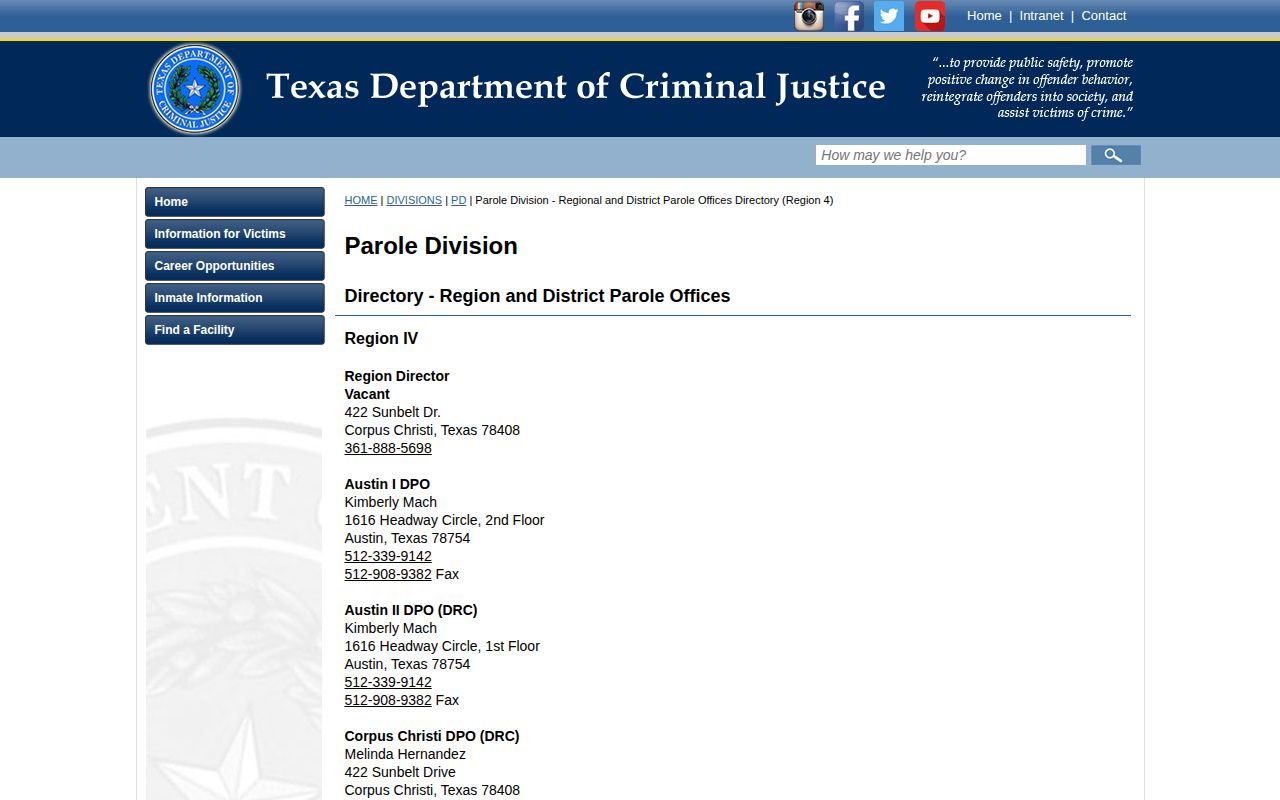
Use the office as a routing point, not as proof of a particular person’s status. Staff may require identifiers and may limit details.
101 Courthouse Square
Cotulla, TX 78014
830-483-5151
Fax: 830-483-5108
No separate published reporting schedule was established in the research. Confirm the current reporting site and instructions with the office and sentencing court before relying on an old document.
La Salle Parole File Review
Ordinary Texas parole consideration does not use a conventional public hearing calendar. The Board says it does not hold formal hearings for parole or mandatory-release consideration. Instead, an Institutional Parole Officer prepares the case summary and a three-member panel reviews and votes the file in sequence. Two matching votes finalize the result; a split sends the file to the third voter.
TDCJ identifies a case roughly six months before initial eligibility and about four months before later reviews. Those are general preparation periods, not promised release dates. The public inquiry is a status and result check, not a courthouse hearing-date search. Use the offender record, Board result guidance, and status line.
The Board parole review process shows how the file moves. The source capture provides context for La Salle County parole checks.
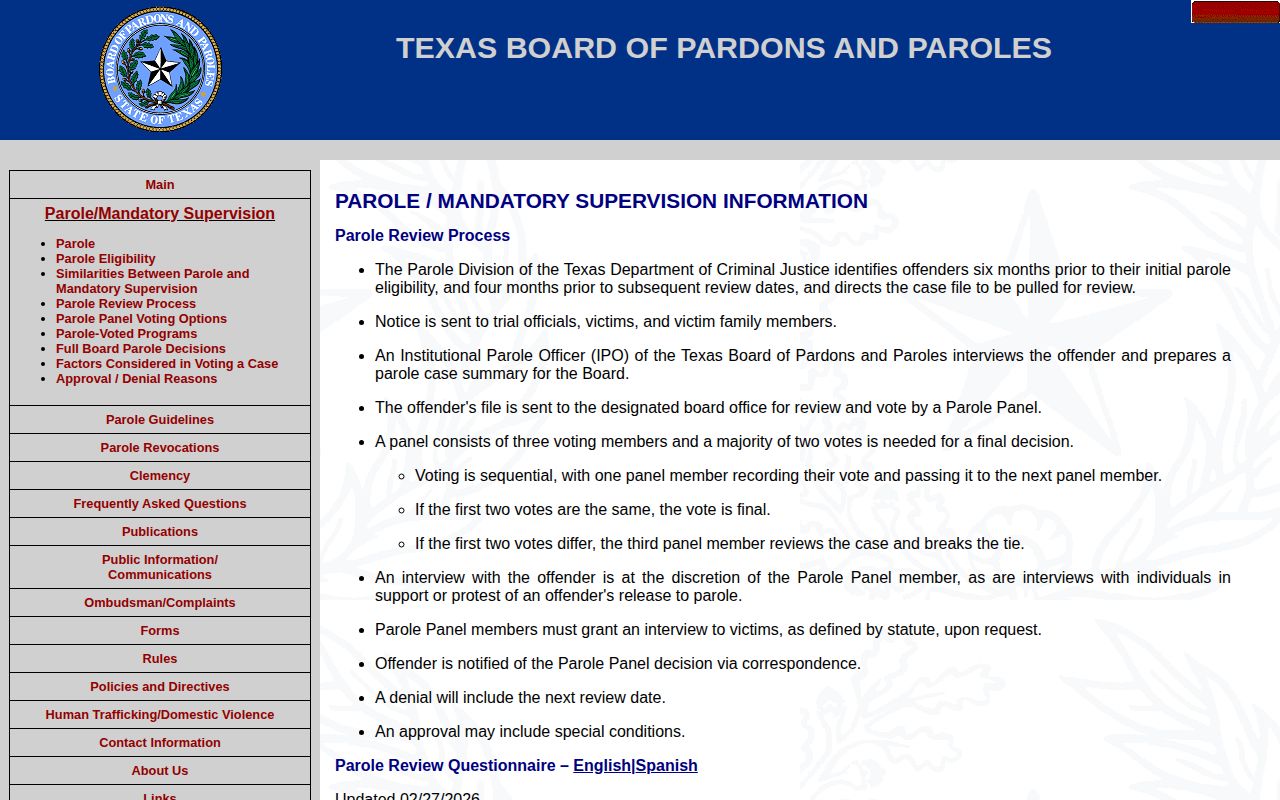
A favorable vote is not always immediate physical release. Review and Release Processing still checks the plan, residence rules, programs, detainers, special conditions, and other criteria before a certificate issues.
Read La Salle Parole Results
Texas vote codes carry details that a simple “approved” or “denied” label loses. FI-1 means release when eligible. FI-2 sets a future month and year. FI-3R, FI-4R, FI-5, and FI-6 tie release to programs. RMS concerns mandatory supervision. The Board can withdraw an approval when new information arrives.
NR is a denial with another review date, while SA means serve all subject to applicable mandatory-supervision rules. CU and DMS codes address consecutive sentences or mandatory-supervision review. A next-review date is not a new projected release date. Eligibility, file review, vote result, release processing, physical release, and discharge remain separate milestones.
La Salle Parole Absconder Checks
Failure to report is not discharge. TDCJ defines absconder status and operates a 24-hour tip line at 866-680-6667 for parolees whose whereabouts are unknown. A warrant can remain active until it is withdrawn or served. The public sex-offender absconder tool covers only people within that registry subset. It is not a universal parole warrant database.
For probation, contact the sentencing court and adult probation office. The court file may contain a motion to revoke, warrant, amended conditions, extension, or discharge order. Do not infer release from supervision because an office will not give details by phone or a notification record disappears.
An arrest on a parole warrant begins a new custody event. The Board may continue supervision, impose an intermediate sanction, or revoke parole. The earlier prison release date remains historically true even when the person returns to custody, so preserve the timeline rather than replacing it with one current-status label.
La Salle Supervision Conditions
Conditions are the enforceable rules of supervision. They can include reporting, residence approval, travel limits, programs, fees, and special terms set by the Board or court. The individual certificate or court order controls. General agency descriptions cannot establish the exact requirements for one person.
A suspected violation does not itself prove revocation. State parole has a defined warrant and revocation process. Probation violations return to the sentencing court through a motion and order process. Seek the warrant, hearing record where applicable, and final decision before describing the outcome.
Confirm La Salle Supervision Discharge
Supervision ends through an official act or recorded sentence endpoint, not through silence. For parole, request TDCJ incarceration and supervision history when the online offender result no longer supplies enough detail. The desired record should identify release type, date, supervision status, and discharge. For probation, request the signed discharge order from the sentencing court and compare it with CSCD records.
Expunction and nondisclosure can later affect access to related court and criminal-history material. Neither should be mistaken for a new discharge date. When records conflict, the originating release record proves the end of custody, and the parole agency or sentencing court proves the end of supervision. The La Salle County release record workflow explains how to preserve the full custody timeline.
Note: A no-match result shows only that the selected system returned no record under the supplied identifiers at that time.
La Salle Supervision Record Trail
A supervision check is strongest when it preserves the order of events. For state parole, begin with the TDCJ identity and prison-release record, then add the Board result, release certificate or processing status, assigned office, and eventual discharge. For probation, begin with the sentencing court's community-supervision order, then add amendments, reported violations, revocation proceedings, extensions, and the signed discharge order. An office contact by itself does not prove that the named person is supervised there.
Identifiers prevent false matches. Use the TDCJ or SID number for parole when available and the cause number for probation. Compare the full name, date of birth, conviction county, court, sentence, and dates. If a person has more than one case, do not merge the terms or assume that discharge in one matter ends every other supervision obligation.
When an agency will not confirm details by phone, request the record from its proper custodian. TDCJ handles state parole and incarceration history. The sentencing court and CSCD handle probation orders and local supervision records. IVSS may provide an event notice for a current person, but its warning about people no longer in custody makes it unsuitable as proof of historical discharge.
A later arrest does not erase the earlier release date. It begins another custody event that can lead to continued supervision, an intermediate response, or revocation. Keep the original prison or jail release as a historical fact and record the new detention separately. The final description should state both the earlier release and the present status supported by agency records.
Public Record Search
Sponsored Results