
Cotulla Unit Release Paths
Cotulla Unit is a state prison operated by the Texas Department of Criminal Justice, Correctional Institutions Division. It does not hold the same legal role as La Salle County Jail. State prisoners may leave Cotulla Unit through parole, mandatory supervision, sentence discharge, or an intrastate transfer. Parole and mandatory supervision are conditional releases to state oversight. A discharge generally marks the sentence endpoint. A transfer changes the place of state confinement without ending TDCJ custody.
The facility's transient custody designation is vital. A person may pass through Cotulla Unit during intake, transport, classification, or another state movement. Disappearance from the unit name is therefore not evidence of release. The statewide TDCJ record should show the current location and available status fields. When public information no longer resolves the history, request the incarceration and release record.
| Outcome | Custody result | Confirm with |
|---|---|---|
| Intrastate transfer | TDCJ custody continues elsewhere | Statewide offender record or locator |
| Parole | Prison custody ends; TDCJ supervision follows | Board result, release processing, parole record |
| Mandatory supervision | Conditional release under Texas law | TDCJ release and supervision record |
| Discharge | Sentence reaches its endpoint | TDCJ incarceration and release history |
Confirm a Cotulla Unit Release
Use the TDCJ online inmate search first. It can show location, offense information, projected release date, and parole-review details within TDCJ's stated inmate-information scope. A seven-digit TDCJ number is the strongest common input. Names can collide, so compare the full name, age or birth information, SID or TDCJ number, conviction county, offense, and sentence before treating a result as the right person.
- Gather the full legal name, TDCJ or SID number, birth information, and conviction county.
- Search statewide, even if Cotulla Unit was the last known location. Do not limit the inquiry to La Salle County.
- Read location and custody fields before reading dates. A new unit means transfer, not release.
- Separate projected release, parole eligibility, next review, and scheduled release. Each field marks a different stage.
- After a favorable parole vote, contact Review and Release Processing with the TDCJ or SID number and date of birth.
- If the public result disappears, request prior incarceration history and the actual release type, date, and supervision status.
A projected date is a TDCJ calculation, not a fixed pickup time. The record may later add a scheduled release date and location after certificate work and audit. TDCJ reports that scheduled-date calculation often takes 14 to 21 business days after Classification and Records receives a certificate, but the estimate is not a guarantee. Program completion, plan approval, detainers, discipline, credit audits, and statutory eligibility can change timing.
The broader La Salle County released-inmate workflow helps route cases among the county jail, state prison, and regional federal or immigration facility.
Cotulla Unit Records and Contact
The official TDCJ Cotulla Unit directory supplies the facility contact. Use the unit for facility-specific operational questions. Use statewide TDCJ information and records channels for a custody history or release record. No hours should be assumed beyond those published for the separate statewide telephone services.
610 FM 624
Cotulla, TX 78014
830-879-3077
Texas Department of Criminal Justice, CID
General TDCJ location information is available at 936-295-6371 or 800-535-0283 during the published weekday service period of 8 a.m. to 5 p.m. The Board parole-status line is 844-512-0461. After a favorable Board vote, Review and Release Processing can be reached at 512-406-5202. These are state-prison channels and should not be replaced with the La Salle sheriff phone.
The no-charge TDCJ email information service accepts a full name plus the seven-digit TDCJ number at pia@tdcj.texas.gov. If the number is unknown, provide exact date of birth, or approximate age and conviction county. Available information can include the TDCJ number, location, current and prior incarceration offenses, county and court, and projected release date. The service expressly does not provide photographs or Social Security numbers.
Cotulla Unit Custody Facts
The state directory identifies Cotulla Unit as a male prison in the Correctional Institutions Division. It opened in July 1992 and has a listed capacity of 606. The custody designations are G1, G2, and transient. G1 and G2 are TDCJ general-population custody levels, while transient describes people moving through the system rather than a stable long-term assignment.
The unit also lists CHANGES/Pre-Release among its programs. CHANGES is a pre-release program within the TDCJ setting, not proof that every person enrolled has a final release date. Program completion may be one part of release planning, while the individual record, Board action, statutory eligibility, detainers, and release certificate still control the outcome.
- Transient custody
- A temporary state placement connected with movement or processing; it does not mean discharge.
- Parole
- Conditional release from prison after discretionary Board action and completed processing.
- Mandatory supervision
- A conditional release route controlled by offense date, eligibility, exclusions, and Board review.
- Discharge
- The end of the sentence or supervision term, distinct from transfer or parole.
Cotulla Unit and Encinal Differ
Cotulla Unit dates to July 1992. Official ICE inspection material says the La Salle County Regional Detention Center opened in 2004. The two sites have different missions, operators, and locators even though both sit within La Salle County. Cotulla Unit belongs to TDCJ and holds state prisoners. The Encinal center is county-owned and currently appears in the ICE directory as a USMS IGA facility.
This distinction prevents a common release error. A person transferred out of Cotulla remains within the state route unless the TDCJ record shows parole, mandatory supervision, discharge, or a move to another sovereign. A person leaving the Encinal center may instead require ICE, USMS, or federal court records. The similar county geography does not merge those systems.
The official Cotulla Unit directory is represented in the matched manifest capture below.
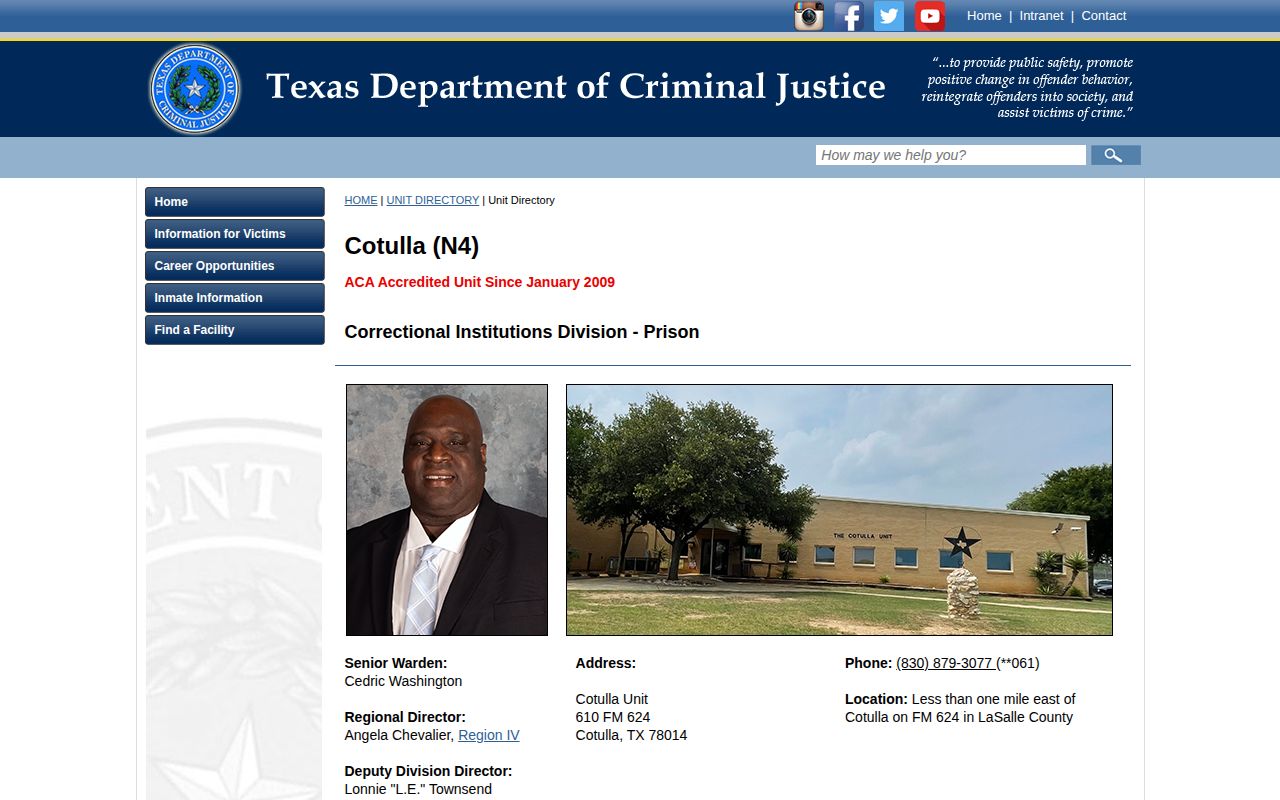
The directory ties Cotulla Unit to TDCJ and provides the facts needed to avoid confusing it with the regional federal or immigration detention route.
Note: A building name or county location never replaces the legal custodian when choosing a release search.
Cotulla Unit Parole Processing
Texas ordinary parole review is a file-vote process, not a standard public hearing calendar. Eligibility only means review can mature. It does not promise approval or physical release. A next-review date after a denial is also not a release date. Favorable FI vote codes may identify a future month or require a program before release.
After approval, TDCJ Review and Release Processing checks the plan, residence compliance, special conditions, programs, detainers, and other criteria before a certificate and schedule are complete. A scheduled release date and location are more advanced than a projection, yet they can still change. Keep eligibility, review, vote, processing, scheduling, and physical release as separate milestones.
La Salle County falls within the Laredo District Parole Office geography. That office is at 6020 McPherson Road, Suite 6, Laredo, TX 78041, telephone 956-724-1933. The geographic assignment does not prove that each person released from Cotulla Unit will report there. TDCJ uses the approved release plan and residence to assign supervision. Confirm the individual instruction before relying on an office address.
Get Cotulla Unit Release Records
Use the no-charge email service first when its published fields meet the need. For documents or a fuller incarceration history, submit a formal request through the TDCJ Public Information Act channel. Identify the person with a full name, TDCJ or SID number, and date of birth when known. State the incarceration period and ask for records as maintained.
A focused request should seek the incarceration history, unit movements, release type, actual release date, release location, and supervision or discharge status. If a field uses a code, ask for the applicable code definition. Electronic format may reduce copying, but the published fee framework is general and not a quote for a specific request. Respond to estimates and clarification notices.
Do not send a Cotulla Unit state-record request to county GovQA merely because the unit is in La Salle County. The county cannot certify a TDCJ parole or discharge. Likewise, a county judgment showing a TDCJ sentence explains the commitment but not the later state movement or release. The state custody history is the proper record.
Verify Cotulla Unit Discharge
A sound conclusion joins three facts: the correct person, the end of TDCJ custody, and the next status. Match the TDCJ number and sentence first. Then obtain an actual release date and type. Finally, determine whether parole or mandatory supervision followed, whether the sentence discharged, or whether another custodian received the person.
If a projected date has passed, confirm whether it was projected or scheduled. Check Board review, program conditions, detainers, discipline, and time-credit audit. Do not convert an FI vote or next-review month into a release date. When records conflict, the newer TDCJ release or movement record carries more weight than a copied listing.
Cotulla Unit's transient role makes this last check essential. A move to another TDCJ unit preserves state custody. A true prison release should have an agency date, a release type, and, when conditional release applies, a supervision path. Preserve all three in the final timeline.
Public Record Search
Sponsored Results