
La Salle County VINELink Transition
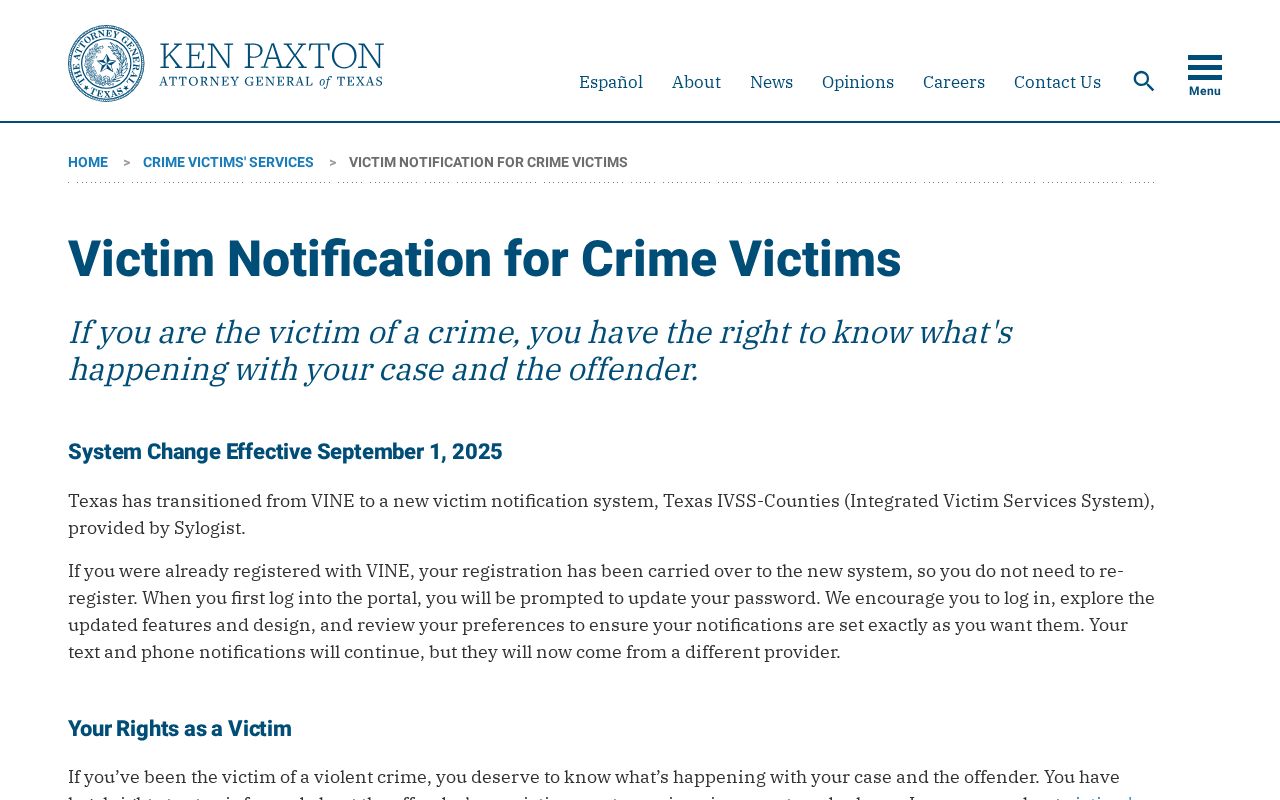
Texas moved county notification registrations from VINE to Texas IVSS-Counties effective September 1, 2025. The Texas Attorney General says existing county VINE registrations were carried forward. A migrated account may require a password update on first login. The current support number is 866-268-8959.
The change matters because familiar VINELink directions can now be stale. Current Texas materials describe portal search, accounts, and contact preferences. They do not document the old four-digit telephone PIN as part of present registration. La Salle County participation in every IVSS function was not independently confirmed through a primary coverage list, so the accurate instruction is to try the portal or call support, not promise that every local booking will appear.
The Texas Attorney General's notification page documents the transition. The matched source image below shows that official state layer rather than an obsolete generic VINE page.
Search a La Salle County Inmate
IVSS can be searched without first creating an account. Use the strongest available identifier and verify several identity fields before selecting a result.
- Open Texas IVSS-Counties and start a person search.
- Enter a permanent booking number, Jail ID, SID, or DOC ID when one is known. Full or partial name is available when no identifier is known.
- Compare the returned name, ID, age or date information, location, and custody or supervision status. Do not select a record on name alone.
- Open the details for the matched person and read the named agency and location before interpreting an event.
- If registration is offered for that record, choose the event and contact preferences supported by the current portal.
- Preserve the alert, then obtain the sheriff, TDCJ, court, or facility record that officially confirms the custody change.
If no match appears, check spelling and identifiers, then call IVSS support. The portal warns that people no longer in custody may not be included. A nonmatch can also reflect agency participation, scope, or a different legal custodian.
Note: A booking number belongs to the jail episode, while SID, DOC ID, A-number, and BOP number belong to different systems.
La Salle IVSS Inmate Search Fields
The service is a notification platform, not a certified release-record archive. Its useful fields help identify a person and follow events, but they must be read within that narrower role.
| Field | What it tells the searcher |
|---|---|
| Full or partial name | Finds possible records, but requires comparison with stronger identifiers. |
| Permanent booking number or Jail ID | Links the result to a county custody episode when the participating agency supplies it. |
| SID or DOC ID | Provides a state-system identifier that reduces name confusion. |
| Custody or supervision status | Reports the platform's current event state, not a certified historical finding. |
| Agency and location | Identifies which participating custodian supplied the record. |
| Contact preferences | Records phone, text, or email choices and permitted contact times when available. |
| Event notification | Signals a custody or supervision change that should be confirmed at its source. |
A La Salle County Jail release record should still provide the actual release date and time, release type, and destination. TDCJ incarceration history supplies the comparable state-prison evidence. IVSS helps the user learn that an event may have occurred; it does not replace either record.
Register for La Salle Release Alerts
Registration begins after the correct person and agency record have been identified. Available choices can depend on the record and participating agency.
- Select the matched record in the current IVSS portal and choose the option to receive notifications.
- Create or update the portal account as prompted. A person with a migrated VINE registration may need to update the password.
- Choose supported contact methods, which may include telephone calls, text messages, and email.
- Set preferred hours or blackout dates when the portal presents those controls.
- Complete the portal's current contact or account confirmation and retain the registration details.
- When an alert arrives, save its event wording and timestamp before calling the originating agency for confirmation.
Registration should focus on the record for one specific person. A user should not treat an alert service as a way to build a general recent-release list. If a formerly confined person later returns to custody, a migrated or continuing registration may remain useful.
Historical Texas VINE PIN Instructions
The old Texas VINE guide described adding a telephone number or email, creating a four-digit PIN, and entering that PIN followed by the pound sign during an automated call. Unacknowledged calls could repeat for a limited period. Those directions describe the former system only.
Do not invent a PIN when the current portal does not request one. Follow the live IVSS account and contact confirmation instead. A help request should go to the current support line, especially if a migrated account or prior registration does not work as expected.
Note: Old VINE instructions can explain a prior registration, but they should not override the current Texas portal's on-screen process.
Limits of La Salle County IVSS
The platform says its search is valid for people currently in custody or under supervision and that people no longer in custody may not be included. It also disclaims status as an official record. This means an absent result cannot establish release, discharge, transfer, removal, or death.
IVSS is not the BOP inmate locator and should not be used for federal custody. A person held at the La Salle County Regional Detention Center may have ICE or USMS custody, depending on the case. ICE ODLS has its own scope, and a federal pretrial prisoner may require the federal docket and facility route. A later BOP designation is a separate record system.
For a person sentenced to TDCJ or last known at Cotulla Unit, the statewide offender search and TDCJ information services are the direct state-prison channels. A movement out of Cotulla Unit can be an internal transfer, since the unit has transient custody. It is not automatically parole or discharge.
Confirm a La Salle County Jail Alert
For the county jail, call the La Salle County Sheriff at 830-879-3044 and identify the booking. Ask whether it ended, the exact date and time, the release type, and the receiving agency if the person transferred. Then use the county GovQA portal for the booking and release record.
A court order explains the legal basis but may not show the precise moment the jail physically released someone. The combined District and County Clerk file can document bond, dismissal, judgment, sentence, or another order. Pair it with the sheriff record. If the sheriff says the person went to TDCJ, ICE, USMS, or another county, follow that receiving system.
For a complete named-person route beyond alerts, the La Salle County released inmate search explains how county, state, federal, and immigration records fit together.
Confirm a La Salle TDCJ Event
TDCJ's public inmate search can show location, offense, projected release date, and parole-review information within its inmate-information scope. Search by TDCJ number when possible. Compare full name, identifying information, conviction county, offense, and sentence before choosing a result.
A projected release date is a calculation, not proof that a person left custody. Scheduled release details appear later in processing and can still change. If the person no longer appears, use TDCJ's information email or formal Public Information Act route to request incarceration and release history. An IVSS event plus the TDCJ record creates a more reliable timeline than either item alone.
IVSS Is Not a La Salle Registry
The Texas DPS sex-offender registry is a separate statutory system for people with Chapter 62 duties. It can contain identity, address, photograph, offense, and registration data. It does not cover released people generally and does not establish the date or manner of release.
Likewise, IVSS does not become a permanent registry because it can include supervision status. Each channel answers its own question. Use the originating agency record to prove the end of custody, and use the applicable supervision or registry agency only for its specific continuing status.
Read a La Salle Custody Alert
Preserve the exact event wording, agency, location, person identifier, and timestamp. “Released,” “transferred,” and a generic custody-status change do not carry the same meaning. If the notice does not name a destination, ask the source agency whether the person entered the community or another custodian's control.
Do not substitute the alert time for the physical release time unless the originating record confirms they are the same. Notification delivery can follow the source event, and phone, text, and email messages may arrive at different times. The agency record remains the source for the official date, type, and receiving facility.
Identity review is just as important after an alert arrives. Compare the permanent booking number, Jail ID, SID, or DOC ID with the original registration. Names alone can collide. Save enough context to show which La Salle County custody episode generated the notice.
Resolve a La Salle IVSS Nonmatch
First repeat the search with the strongest identifier and verify that the person belongs in a county or state notification system. A USMS or ICE case at the Encinal center may require a different locator. If the expected county or TDCJ record still does not appear, call IVSS support at 866-268-8959 and ask about current portal coverage or the account.
Then contact the originating custodian. For La Salle County Jail, request the release or transfer record through the sheriff and GovQA. For TDCJ, use the inmate-information and records channels. State the result as a nonmatch until an agency record establishes what occurred. This prevents a portal limit, spelling variation, or completed custody episode from being mislabeled as release.
Public Record Search
Sponsored Results