
La Salle Release Date Meanings
The label matters as much as the date. A projected date is a TDCJ calculation based on the sentence, offense date and type, calendar time, credits, legal eligibility, and release law. It is not a promise that a person will walk out that day. A parole eligibility date marks when discretionary review may mature. A next review date follows a Board result and is not a new release forecast. A scheduled date and location appear only after release work has advanced, but even that plan can change.
An actual release date records when one custodian ended its custody episode. It should be read with the release type and destination. A transfer from La Salle County Jail to TDCJ, ICE, USMS, or another sheriff ends the county booking but does not mean community release. The same care applies when someone leaves Cotulla Unit for another TDCJ unit.
| Field | What it means | What it does not prove |
|---|---|---|
| Projected Release Date | TDCJ forecast under sentence and credit rules | A fixed pickup day |
| Parole Eligibility | Date review can mature under governing law | Parole approval |
| Next Review | Board review point after a result | A new release date |
| Scheduled Release | Advanced operational plan after processing | An unchangeable event |
| Actual Release | End of one agency's custody episode | Freedom from every hold or agency |
Find a La Salle Projected Release
Begin with the last legal custodian. The TDCJ online inmate search is the right first source for a sentenced state prisoner, including a person associated with Cotulla Unit. The county sheriff and criminal court are the right sources for a La Salle County Jail sentence. A pretrial booking usually has no computed release date at all. Bond may be set without being posted, and another hold may block release after the local case changes.
- Collect the full name, date of birth, and the correct agency number. A seven-digit TDCJ number is stronger than a name alone.
- For state custody, search TDCJ and match the name, age, number, conviction county, offense, sentence, and current location.
- Read each field by its exact label. Keep projected release, parole eligibility, next review, and scheduled release separate.
- For county custody, call the La Salle County Sheriff at 830-879-3044 and ask whether the booking is pretrial or sentenced and whether any release or transfer record exists.
- Use the combined District and County Clerk record to confirm the judgment, sentence, jail credit, bond order, dismissal, or later court action.
- If a projected date has passed, recheck the live record and ask the proper agency about parole review, program conditions, time-credit audit, detainers, or other processing.
The full named-person release and transfer workflow is available on the La Salle County released-inmate search. Do not treat a missing search result as release. TDCJ describes its public tool as inmate information, not a permanent archive for every discharged person.
Note: A county court order can change legal status before jail staff complete the physical release or transfer record.
La Salle TDCJ Date Fields
TDCJ information may show location, current and prior incarceration offenses, conviction county and court, projected release date, and parole-review information. The detail may later gain a scheduled release date and location. TDCJ says that after a release certificate reaches Classification and Records, its audit and scheduled-date calculation generally takes about 14 to 21 business days. The date can change without notice because a release certificate is one milestone, not physical discharge.
The no-charge TDCJ email information service is a useful fallback. Send the full name and seven-digit TDCJ number to pia@tdcj.texas.gov. When the number is unknown, provide an exact birth date, or an approximate age and conviction county. The service can return the fields within its published scope. It does not supply photographs or Social Security numbers.
The manifest image below comes from the official TDCJ offender search.
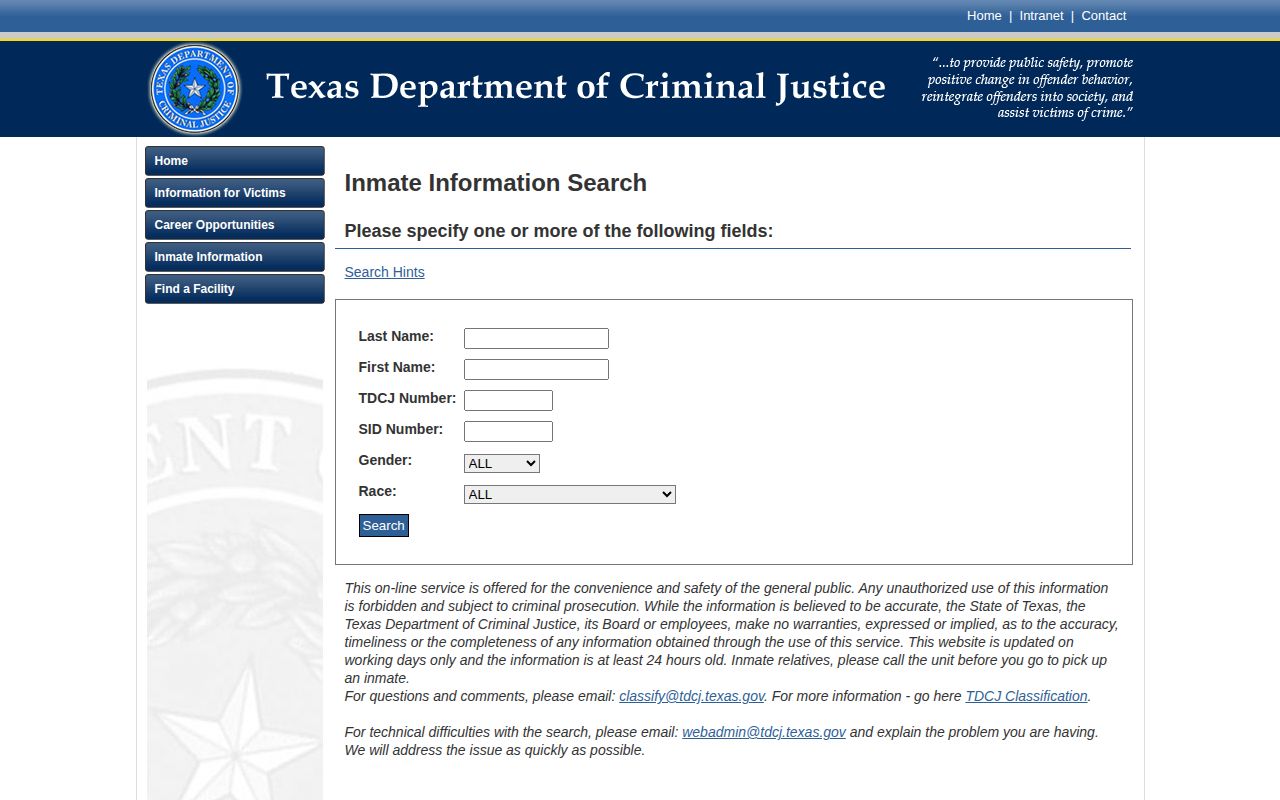
Use the query screen to reach the individual record, then compare identifiers before relying on its projected release fields.
Texas Credits for La Salle Releases
Texas Government Code Chapter 498 governs state good-conduct time. These credits can affect classification and eligibility within the TDCJ framework, but Section 498.003 states that good-conduct time is a privilege and does not reduce the sentence itself. Credits may be forfeited for misconduct, and a credit decision or audit can move a projected release date.
Texas does not have one general rule requiring every prisoner to serve 85 percent of a sentence. The often-repeated shortcut is wrong for this state. Government Code Chapter 508 sets offense-specific parole and mandatory-supervision rules. Section 508.145(d) includes a serious-offense category in which parole eligibility generally requires actual calendar time, without good-conduct time, equal to half the sentence or 30 calendar years, whichever is less, subject to the statute's minimums and details. That is an eligibility threshold, not a promised release date.
- Good-conduct time
- A TDCJ privilege that can affect classification and eligibility but does not erase the sentence.
- Mandatory supervision
- A conditional state release governed by eligibility, offense date, and Board rules.
- Detainer
- A request or hold from another authority that may affect where a person goes next.
- Discharge
- The end of the sentence or supervision endpoint, distinct from a transfer.
La Salle County Jail Time
County jail credit must not be computed with TDCJ formulas. Texas Code of Criminal Procedure Article 42.032 addresses county-jail good conduct for eligible county sentences, while Article 42.03 addresses credit ordered in the judgment. The sheriff administers local jail custody, and the court judgment controls the sentence. No official La Salle source was found stating a local award rate, forfeiture method, weekend rule, or release-hour policy.
Ask for the judgment, sentence, and credited days from the combined District and County Clerk. Then request the jail's calculation or release record through the county's open-records gateway and GovQA. Do not import another Texas county's credit schedule. If the person is pretrial, ask about bond and court status instead of demanding a projected date that the jail may not maintain.
No. Bond creates a possible route out of the local booking. Posting, other holds, processing, and a transfer decision can still control whether and where the person leaves.
Note: La Salle County publishes no verified local good-time rate, so an individual calculation must come from the jail and sentencing court.
Why La Salle Release Dates Change
A date may move for reasons that arise from law, custody, or processing. A change is not proof of an error. Compare the latest agency record with the prior field and ask which event caused the revision.
| Factor | Possible effect | Best confirming source |
|---|---|---|
| Credit audit or forfeiture | Recalculates a TDCJ projection | TDCJ Classification and Records |
| Parole decision | Approval, denial, setoff, or program condition changes the path | Board result and TDCJ processing |
| Required program | Release waits for completion tied to the vote code | TDCJ record and release processing |
| Detainer or warrant | May send the person to another custodian | Holding and receiving agencies |
| Court order | Changes sentence, credit, bond, or legal authority | Signed court order and jail record |
| Release-plan review | Residence or special-condition review delays scheduling | TDCJ Review and Release Processing |
An FI parole vote is not always immediate release. FI-2 names a future month and year, while program-linked FI codes require completion before release. The Board can also withdraw approval after new facts. Translate the actual code, then check processing status.
La Salle Parole Date Milestones
Parole adds a second timeline to a projected release date. Ordinary Texas parole review is a file-based process, not a public event with a routine hearing date. An institutional parole officer prepares the case summary, and panel members vote in sequence. The useful public markers are eligibility, review status, result code, next review, release processing, and the final scheduled date. None should be renamed “release date” unless TDCJ uses that field.
A denial can produce an NR result with another review month and year. Special categories can receive longer setoffs. SA and program or mandatory-supervision codes require close reading. A favorable vote may be tied to a future month, a treatment program, or another condition. The release plan must also pass review. A parole certificate then moves into classification, records, and scheduling work.
For eligible mandatory-supervision cases before September 1, 1996, TDCJ explains that release may occur on the projected date if parole has not occurred. For eligible offenses on or after that date, mandatory supervision is discretionary with the Board. If the person is not approved or is excluded by law, the projected date may instead function as the discharge date. Section 508.149 contains exclusions, so the offense date and exact conviction matter.
Keep five milestones distinct: eligibility, review, vote, release processing, and physical release. A favorable vote does not complete the chain. A next-review month does not replace the projection. When the online record and a family notice differ, record both labels and dates, then ask TDCJ which stage is current.
Confirm a La Salle Release
After parole approval, TDCJ Review and Release Processing checks the plan, residence, special conditions, required programs, detainers, and other criteria before the certificate and final schedule are complete. A current date should be confirmed there or through the published TDCJ information channel. For county custody, obtain the sheriff's release or transfer record. For either route, keep the destination with the date.
A notification service can help track a future event, but it is not a certified release document. Texas moved county VINE functions to IVSS-Counties, and participation details for every La Salle function were not independently confirmed. The VINELink inmate search page explains the current Texas notification route. A missing person in that portal does not prove release.
For Cotulla Unit, absence from the unit is especially weak proof because it is a transient TDCJ facility. A person may leave Cotulla yet remain in state custody. Search the statewide TDCJ record and request incarceration history if the public record no longer resolves the timeline.
Public Record Search
Sponsored Results